English from zero, one planet at a time.
Free mini-games for kids, adult beginners and families. All 102 lessons, no account needed.
Who's learning?
play one round right here
Pick who is learning, then match each picture to its word. In the app, every word is also read aloud.
a new game every lesson
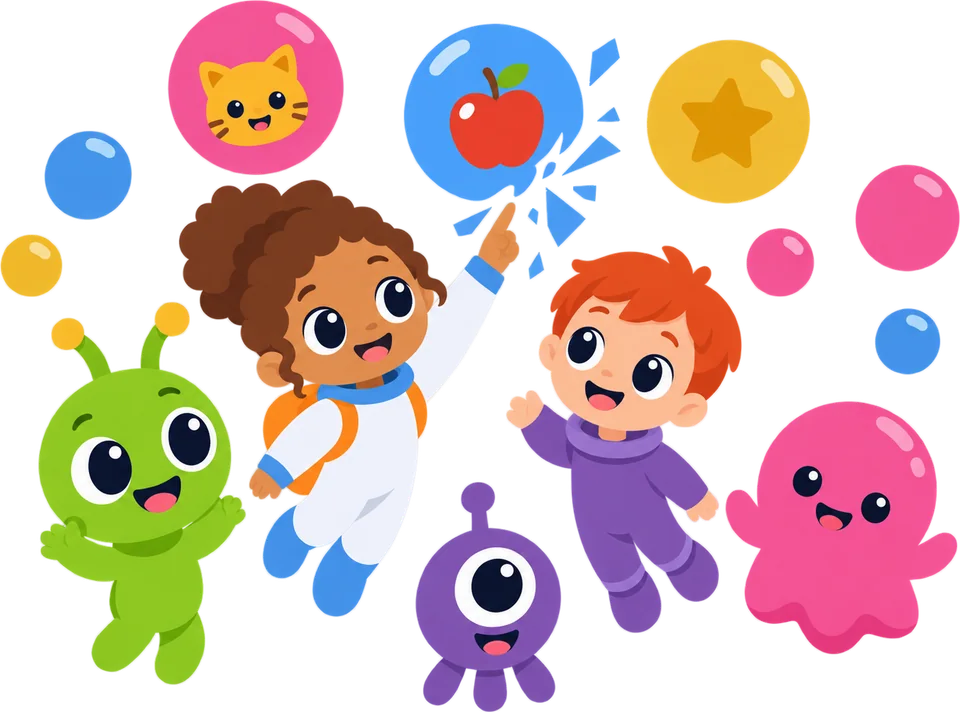
From age 6, each lesson starts with a spin of the Game Wheel. It lands on one of the games that fit that lesson, like bubble pop or word builder. Kids aged 3 to 5 skip the wheel and get a game picked for them.
Ages 3-5
Tap stuff, pop bubbles, match pictures. Big visuals and simple words, with lots of sound effects.
Matching, Bubble Pop, Memory
Ages 6-7
Spelling words letter by letter, dragging answers into place, hunting for hidden words. Harder vocab.
Word Builder, Drag, Hunt, Scramble
Kids & Adults
Actual sentences. Following spoken instructions. Reading short stories. Having conversations. Also works for adult beginners starting English from zero.
Dictation, Conversation, Chain, Story
stories that read along
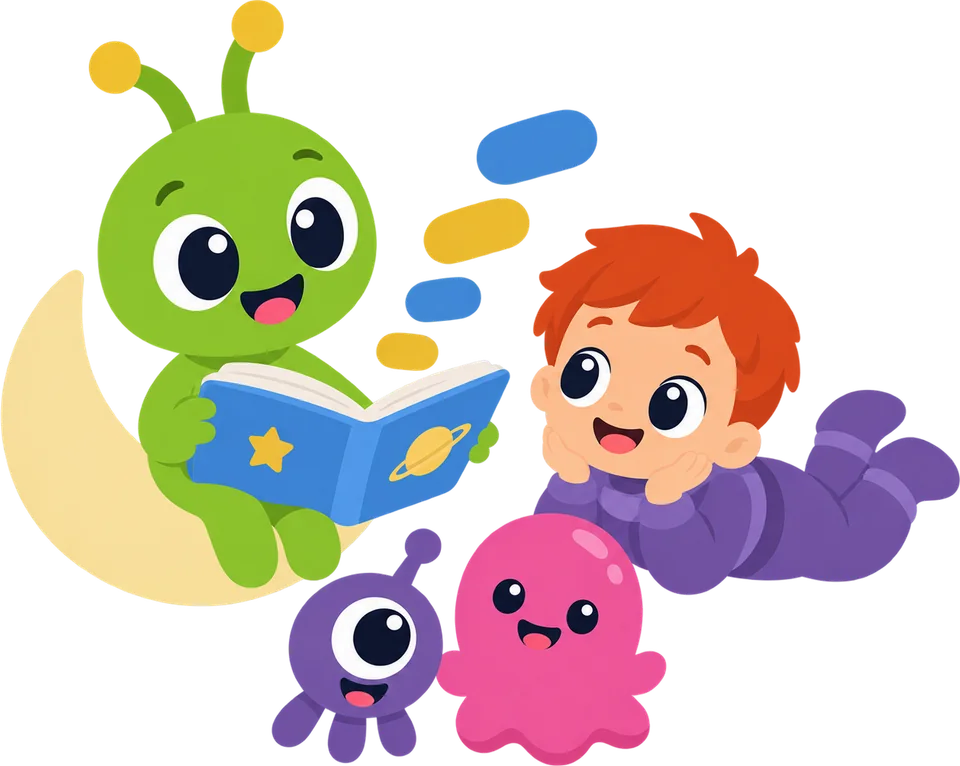
Every planet has a classic fairy tale, and its book opens after the first lesson there. Each word lights up as it is read aloud. Tap a word to hear it on its own, and some harder words also show a short meaning in simple English.
a crew to collect
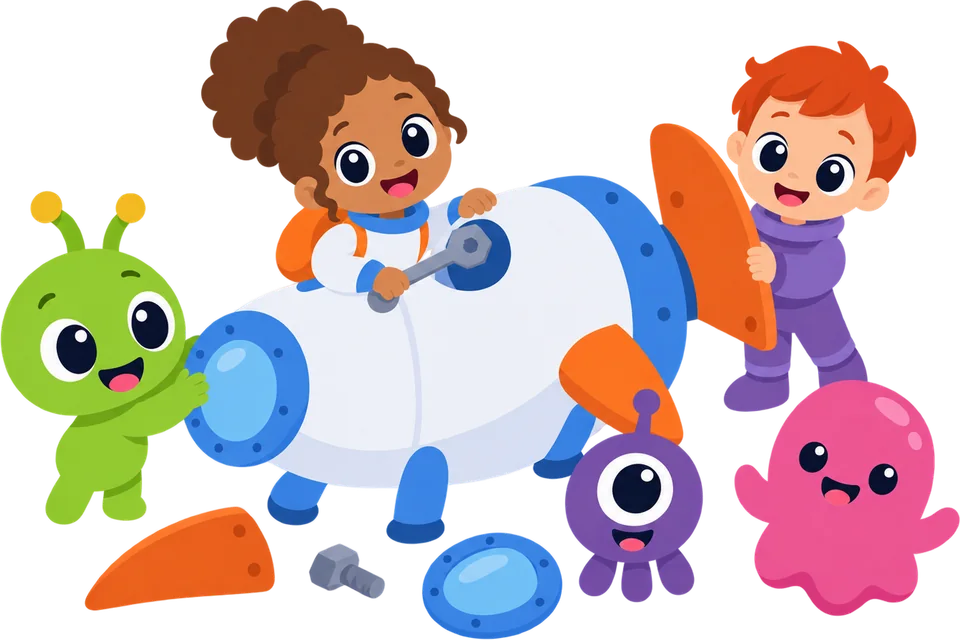
Finished lessons turn up 20 alien creatures and earn coins, and coins buy parts for your spaceship, so progress is something you can see. Kids get an adventure. Adults get a low-pressure reason to come back.
seven planets, 102 lessons
Start on Earth with animals, colours and family, then travel out to Pluto for robots, dream jobs and world cultures. Finishing a lesson opens the next one.
- EarthThe stuff kids already know but can't say in English yet. Animals, colours, family, body parts, weather, counting.
- MarsFeelings, school, meals, sports, health: the words kids need to describe their actual day.
- JupiterBigger words, weirder topics: ocean creatures, outer space, insects, holidays and the first science words.
- SaturnHarder words for kids who are ready, on art, opposites, materials, technology, the environment, shopping and travel.
- NeptuneThe words kids use at home but never learned in English. What's in the kitchen, what's in the garden, how to ask for directions.
- UranusDinosaurs, fairy tales, pirates, superheroes. The practical stuff comes mixed in: telling time, counting money, naming the months.
- PlutoThe big ideas. Space exploration, robots, world cultures, dream jobs, recycling. Vocabulary that makes a kid sound like they actually know things.
for kids and grown-ups
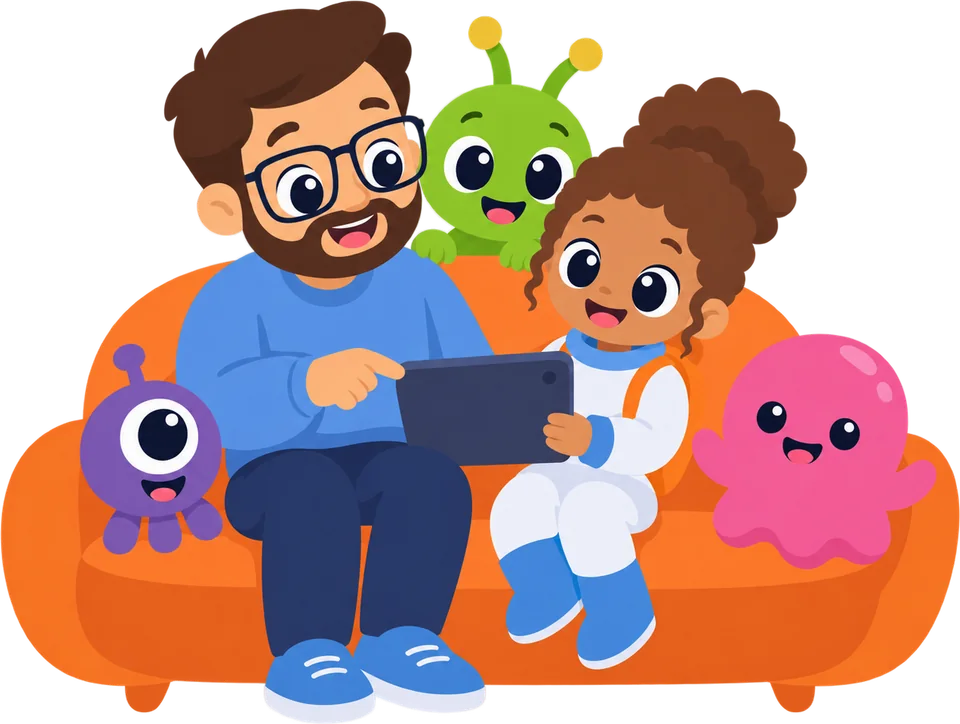
Up to four people can share one device, and each of them keeps their own progress. Adults starting English from zero follow the same path at their own pace.
- All 102 lessons free, no subscription
- No ads and no payments
- Play as a guest, no sign-up
- Plays offline after one visit on Wi-Fi
what families tell us
“My 4-year-old asks to 'play the alien game' every morning. She doesn't even realize she's learning English. She just thinks she's helping aliens.”
“I’m an ESL teacher and this is the first app I’ve told parents to actually download. The no-translation thing is what we do in class: learn from context, not word lists.”
“I love that there's nothing to buy inside the game. My kids use it on the iPad and I don't worry about them seeing something inappropriate or accidentally purchasing anything.”
questions, answered
Small Universe is a free English learning game that runs in the browser. It has 102 short lessons across 7 planets, 17 mini-games and 7 read-along fairy tales, covering about 950 words from CEFR Pre-A1 to B1. Children from age 3, adult beginners and families can play as guests, with no account, no ads and no subscription.
No. It was built with young learners in mind, but learning without translation works for complete beginners of any age. Adults starting English from scratch begin at Earth and work through the planets at their own pace, and the game mechanics turn out to be surprisingly engaging for them too. If you're a total beginner, age doesn't matter.
It started as a kids app for ages 3 to 10, but the learning path also works for teens and adult beginners starting from zero. Younger kids get simpler tap-and-match games. Older learners also get dictation, conversation, sentence building and harder vocabulary.
Yes. All 102 lessons, 17 game types, and 7 planets are free. Cloud backup is free too, and all it needs is an optional parent sign-in. If we add paid features later, they will be optional add-ons (speaking practice, teacher tools) and will not block the lessons you can play today.
No. Real-money payments are switched off, so nothing in the game can be bought with money. Finished lessons earn coins, up to 100 a day, and coins buy spaceship parts, hats, hearts and streak freezes in the in-game Shop. The Shop also lists coin packs, but they cannot be bought.
Only for the first visit. Open the game once on Wi-Fi and it saves the game and its lesson audio on the device. After that it plays offline, on a plane, in a car or at home with bad Wi-Fi. Pictures for lessons you have not opened yet may show as plain emoji until you are back online.
It runs in the web browser on iPad, iPhone, Android phones and tablets, and computers (Safari, Chrome, Edge or Firefox). There is nothing to download from the App Store or Google Play: open smalluni.com and start playing. For an app icon, add it to your home screen from the browser's share or menu button.
You can play as a guest with no sign-up, and guest progress stays on the device. Signing in is optional. If a parent signs in with their email, we back up and sync progress across devices, and for that we store the parent's email plus each profile's name, age, avatar and progress. We never track the child or sell data, and there are no ads in the game. The privacy policy has the full picture.
No translation drills. Following Krashen's Comprehensible Input theory, learners work out meaning from context, pictures and sound while they play. Words come back in different game types, so review feels natural.
There are 102 lessons spread across 7 planets (Earth, Mars, Jupiter, Saturn, Neptune, Uranus, Pluto), with 14-16 lessons per planet. The lessons are played through 17 different game types, among them matching, memory, bubble pop, word builder, dictation and conversation.
Yes. Up to 4 people can have their own profile on a single device. Each profile keeps its own name, avatar, lessons, stars, hearts, streak and age-matched games. The alien crew and the spaceship are shared by everyone on the device.
None, and that's the point: no other language is required. Learners go by the pictures and sounds as they play, so it works whatever language they speak at home.
Every word, sentence and story has its own audio clip, with clear, natural-sounding narration and the same pronunciation each time. It is not the device's robotic built-in voice. As a story plays, each word lights up in time with the narration, so kids can read along and hear how English sounds.
Each planet has its own fairy tale, and its book opens on the in-app bookshelf after the first lesson there: a classic story such as Three Little Pigs, The Tortoise and the Hare or The Ugly Duckling, read aloud. Each word highlights in time with the audio, like karaoke. Kids can tap any word to hear it on its own, and some harder words also show a short meaning in simple English. Finished stories go on a personal bookshelf, and tapped words are saved to a word list kids can listen to again.